

Honeycomb Seals and Honeycomb Cores in Superalloys for Turbines and Compressors
ISTAM manufactures metallic honeycomb cores in superalloys in Italy. They are built to the customer’s technical specification for aerospace, power generation and industrial applications.
Honeycomb seals are sealing systems used in turbines, compressors and turbomachinery to limit gas or steam leakage between rotating and stationary components.
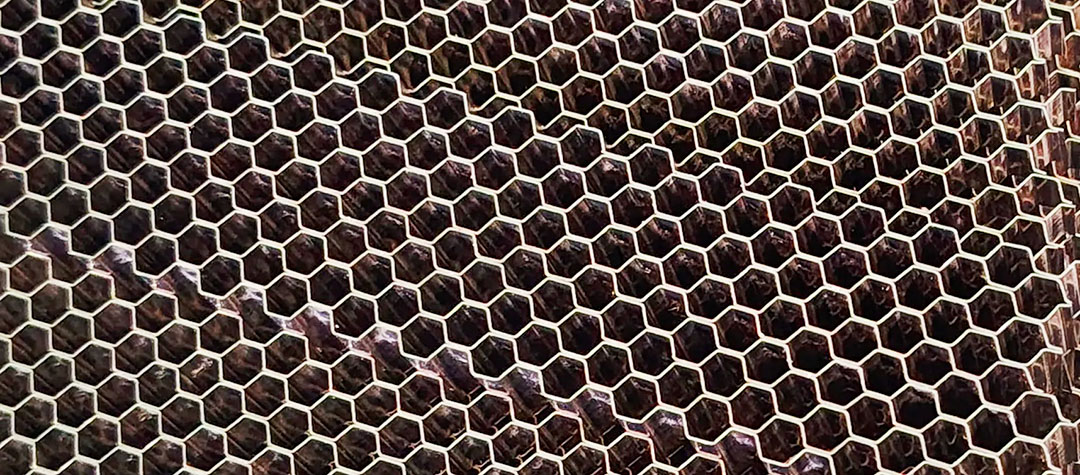
Their sealing surface is a metallic honeycomb core. This is an open-cell, geometrically controlled structure that reduces fluid passage, allows tighter rotor-to-stator clearances, and manages incidental contact with rotating parts.
What is a honeycomb seal?
A honeycomb seal is used in high-performance rotating machinery to control fluid leakage between stationary and rotating elements. The stationary sealing surface is lined with a metallic honeycomb structure. As gas or steam flows through the open cells, it generates flow resistance and energy dissipation. This blocks unwanted fluid passage and helps maintain machine efficiency over time.
What's the difference between a honeycomb core and a honeycomb seal?
The honeycomb core is the alveolar metal structure itself. It is made of open cells, formed by assembling thin metal strips and joining them by spot welding into a regular, stable geometry.
The honeycomb seal is the complete sealing assembly in which that core is integrated. It is shaped and applied to supports, rings or metal segments, typically by brazing, according to the component's design. The core is the functional element. The seal is the finished component built around it.
How does a honeycomb seal work?
During turbine or compressor operation, part of the process fluid can pass through the clearance between the rotor and the stationary part of the machine. The honeycomb cell geometry disrupts that path. It generates localized pressure variations and micro-vortices. The fluid loses energy as it passes through the seal, and leakage flow is reduced as a result.
Sealing performance depends on several design parameters:
Honeycomb geometry is never generic. It has to be engineered around the operating conditions of the specific turbomachine.
Abradable behavior: clearance control and rotor protection
One of the most valuable properties of honeycomb structures is their abradable nature. They are designed to wear away in a controlled manner on contact with a rotating part. During start-up, shutdown, or changes in operating conditions, thermal expansion and rotor movement can temporarily reduce the available clearance. This can bring blade tips or labyrinth teeth into contact with the honeycomb structure.
When that happens, the honeycomb deforms or wears locally instead of damaging the rotating component. The rotating component is typically the more critical and expensive part to replace. This allows tighter design clearances and lower leakage without compromising operational safety. The seal adapts to the machine, not the other way around.
Reducing leakage in turbines and compressors
Any fluid that crosses the seal without contributing to the energy conversion process is an efficiency loss. Honeycomb seals help on several fronts:
Experimental studies across different configurations show leakage reductions compared with smooth surfaces and some traditional sealing solutions. Results still depend on cell geometry, clearance, pressure and inlet flow pre-swirl conditions.
Honeycomb seals vs. labyrinth seals
Traditional labyrinth seals use a series of teeth and chambers to generate progressive pressure drops. In honeycomb labyrinth seals, the smooth surface opposite the teeth is replaced with a honeycomb structure. This increases flow-path complexity and changes the seal's fluid-dynamic behavior.
Neither solution is automatically the right choice. The decision depends on:
How metallic honeycomb cores are manufactured
Production starts from thin metal strips, formed into a regular sequence of cells. The process typically includes:
Process precision is not a detail here. Cell size, depth and uniformity directly affect the finished component's behavior. ISTAM manufactures its honeycomb structures to customer drawing or specification. There is no single product standard, since each application calls for a different combination of material, thickness and geometry.
Materials for high temperature and severe operating conditions
Honeycomb cores for turbines, compressors and aircraft engines have to withstand high temperatures, oxidation, mechanical stress and aggressive operating environments. ISTAM manufactures honeycomb cores in the following alloys and materials:
Material selection depends on operating temperature, fluid composition, the intended brazing process, and the mechanical properties required.
ISTAM integrates the honeycomb core onto metallic supports, rings or segments using nickel-based brazing alloys compliant with AMS specifications. These include:
The specific alloy is selected based on the base material and the final component's operating conditions.
Is Hastelloy a special steel?
No. It is often informally called a special steel because of its high-temperature resistance. Hastelloy is actually a nickel-based superalloy. It is metallurgically different from steels, which are iron-based. ISTAM works with Hastelloy X to manufacture honeycomb cores for gas turbines, steam turbines and industrial compressors.
Available cell sizes
ISTAM manufactures honeycomb cores in the following cell sizes: 3.2 mm, 4.8 mm, 6.4 mm, 9.5 mm, 12.7 mm and 19 mm.
The 3.2 mm size is the most requested for technical applications. This range fits industrial applications, compressors and medium-to-large cell abradable components well. Fine-cell precision seals below 3.2 mm are typical of some high-speed aerospace applications. Feasibility for these should be confirmed directly with ISTAM on a case-by-case basis.
Quality and certifications
ISTAM manufactures certified components under EN 9100:2018 and ISO 9001:2015. These certifications are issued by Kiwa Cermet Italia under ACCREDIA accreditation.
They cover the production of cold-stamped sheet metal parts and the assembly of technological sub-assemblies for the industrial, aerospace and automotive sectors. These are the same fields in which honeycomb cores are used.
Where honeycomb seals are used
Honeycomb structures are used wherever there are high-speed turbomachines and severe operating conditions.
Aircraft engines and the aerospace sector
In aircraft turbine engines, honeycomb structures can be used wherever clearance control between rotating and stationary parts is needed. This limits leakage and protects components in case of contact.
Gas turbines
In gas turbines for power generation, honeycomb seals help manage internal flows and maintain machine efficiency.
Steam turbines
Honeycomb seals can be used in steam turbines to reduce leakage between machine sections and manage contact with rotating components.
Centrifugal compressors
In industrial compressors, honeycomb seals control gas leakage. In certain configurations they also contribute to the system's rotordynamic stability.
Honeycomb core manufacturer in Italy
ISTAM has been in business since 1973. It has worked in the aerospace sector for 25 years, specializing in thin sheet metal processing, forming and spot welding of components in aluminum, steel and special alloys. Since 2023, ISTAM has invested in dedicated equipment to extend this expertise to the production of honeycomb cores in superalloys. It is now one of the few specialized Italian manufacturers in this field.
ISTAM is a member of the Piedmont Aerospace District. This is the association bringing together the main players in Piedmont's aerospace sector, including companies, research institutions and public bodies.
Why choose custom-specification honeycomb cores
Every seal operates under different conditions. Pressure, temperature, speed, fluid, clearance and material all change from one application to the next, and so does the behavior required from the honeycomb structure. Manufacturing to specification means being able to adapt material, strip thickness, cell shape and size, structure depth, blank dimensions and the configuration needed for downstream integration.
Working with a specialized manufacturer means arriving at a solution consistent with both the application's technical requirements and the assembly or brazing processes that follow.